Freezone Company Formation
Freezone Company Formation in Egypt can provide investors and entrepreneurs with a practical base for expanding into international markets while benefiting from available tax and customs incentives.

Whether you are a foreign investor planning export activities or an Egyptian business owner exploring cost-efficient growth opportunities, understanding the legal structure and operating rules of free zones is essential. This 2026 guide outlines the key points you need to know before starting the Freezone Company Formation process in Egypt.
Also Read: Freezone Business Setup in UAE – Complete Guide
What Are Egypt Free Zones?
Freezone Company Formation takes place within designated areas that remain part of the country’s territory, fall within its geographical borders, and remain under the supervision of national administrative authorities. However, business activities and transactions conducted within these zones are governed by special tax, customs, and monetary regulations.
How Do Egypt’s Free Zones Operate?
Freezone Company Formation in Egypt takes place within specially designated areas that follow a separate legal, customs, and tax framework from companies registered under the standard system. Businesses established in these zones are not treated in the same way as ordinary companies registered with the Egyptian Tax Authority or the traditional Commercial Registry.
Egypt’s free-zone model is designed to encourage manufacturing, service delivery, and international trade by providing eligible companies with customs and tax incentives. In return, free-zone businesses are generally expected to export a substantial share of their products or services, helping support the country’s foreign trade activities.
The General Authority for Investment and Free Zones (GAFI) is responsible for managing and regulating investment within these zones, while the Ministry of Finance and the relevant customs authorities supervise customs-related operations. The current regulatory framework also focuses on simplifying procedures, digitizing approval processes, and positioning Egypt as a dependable destination for international manufacturing and export-focused investment.
Main Types of Free Zones in Egypt
Egypt’s free-zone system is divided into three primary categories, with each type serving different business activities, investment goals, and operational requirements. Understanding these categories helps investors select the most suitable legal structure for their available capital and planned Freezone Company Formation activities.
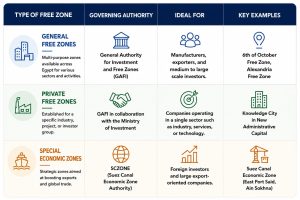
Note: The table above provides a general overview of Egypt’s main free-zone categories. Requirements such as minimum capital, land allocation, and licensing fees may be revised periodically in line with government regulations. Contact the AHG team to obtain the latest information before proceeding with Freezone Company Formation.
Benefits, Legal Protections, and Tax Advantages of Egypt’s Public and Private Free Zones
Companies operating within Egypt’s public and private free zones enjoy a wide range of incentives under Law No. 72 of 2017 and its Executive Regulations. These provisions are designed to support investment, simplify business operations, and encourage export-oriented activities through attractive legal and financial advantages.
Key Investment Benefits
Businesses established through Freezone Company Formation can benefit from several investment incentives, including:
- The ability to transfer invested capital and generated profits abroad.
- Freedom to select the investment activity and legal structure that best fits the business.
- Full flexibility to determine product pricing and profit margins.
- No minimum or maximum capital requirements for projects established in general free zones.
- No restrictions on foreign ownership, allowing international investors to own projects fully or partially, except where special regulations apply in Sinai.
- The option to operate on behalf of third parties and utilize project capacity, subject to GAFI regulations.
- Residency privileges for foreign investors, along with residence permits for foreign employees based on operational needs.
Legal Guarantees for Investors
Egyptian free-zone projects also receive important legal protections that strengthen investor confidence, including:
- Legal proceedings against free-zone companies cannot be initiated without prior consultation with GAFI.
- Projects and their assets cannot be nationalized or confiscated.
- Administrative actions such as asset seizure, freezing, guardianship, or fund attachment cannot be imposed without a court order.
Tax and Customs Exemptions
Public and private free-zone companies benefit from significant tax and customs relief, including:
- Customs duties, sales taxes, and similar charges are waived on capital equipment and production inputs required for the project, excluding passenger vehicles.
- Imports from abroad and exports to international markets are exempt from customs duties, taxes, and applicable government fees.
- Projects and their profits remain outside the scope of domestic tax and customs legislation throughout the operating period.
- Standard customs clearance procedures and import restrictions do not apply to international trade conducted by free-zone companies.
- Goods purchased from the domestic market for eligible project activities are exempt from Value Added Tax (VAT).
- Transit goods destined for specific foreign locations are exempt from import and export duties, provided the project is located within the customs zone and the final destination is clearly stated on the shipping documents and commercial invoice.
- Products manufactured within free zones that contain local components receive customs-duty exemptions on those local components when sold in the Egyptian market.
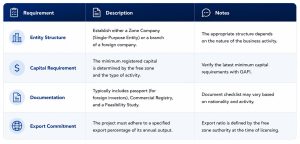
Eligibility Requirements for Freezone Company Formation
Before beginning the Freezone Company Formation process, the founding partners must satisfy several basic conditions:
- The planned business activity must be approved within the selected free zone.
- A detailed feasibility study must be prepared and submitted for review.
- The project must be able to meet the required export percentage of its annual production.
- The founders must have sufficient financial resources to establish and operate the business.
- All founding partners must have a clean commercial record and no unresolved legal judgments.
Freezone Company Formation: Step-by-Step Registration Process
Freezone Company Formation in Egypt involves several official stages that investors must complete before the business can begin operations.
Step 1 — Select the Most Suitable Free Zone
Choose the free-zone category that best matches the proposed business activity, whether it is a general, private, or special economic zone. Important considerations include the zone’s location, access to ports, available industrial space, and the quality of its infrastructure.
Step 2 — File the Initial License Application
Submit the preliminary application to the relevant free-zone authority or through GAFI’s electronic platform. The application should include details about the planned business activity, estimated investment value, and expected number of employees.
Step 3 — Obtain Preliminary Approval
The competent authority reviews the application and decides whether to grant initial approval or reject the proposal. Once preliminary approval is issued, the investor must provide a detailed feasibility study for further assessment.
Step 4 — Complete the Lease Agreement
After receiving approval from the zone’s board, the investor signs a lease agreement for the allocated land, industrial unit, or business premises. The applicable contractual and allocation fees must also be paid at this stage.
Step 5 — Receive the Final License and Register the Company
The final operating license is issued, and the company is formally registered within the selected free zone. The business can then open its tax file and customs record under the registered company name.
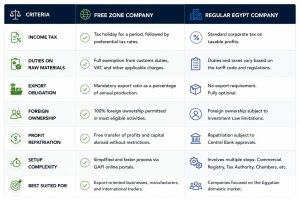
Free Zone Company vs Regular Company: Which Option Is More Suitable?
Choosing between Freezone Company Formation and establishing a regular company in Egypt depends mainly on the markets you intend to serve and your long-term business objectives. A free-zone company may be more suitable for export-focused activities seeking customs and tax advantages, while a regular company is generally better positioned to trade directly within the Egyptian market.
Leading Free Zones in Egypt
Egypt’s free zones are located in strategically selected areas that provide convenient access to major ports, industrial centers, and regional trade routes. These locations support different forms of Freezone Company Formation, from manufacturing and logistics to technology and service-based investment.
6th of October Free Zone
Located in Giza near Cairo, the 6th of October Free Zone is one of Egypt’s largest and longest-established free zones. It hosts companies operating in several industries, including food production, pharmaceuticals, electronics, and business services.
Alexandria Free Zone
The Alexandria Free Zone benefits from its proximity to Alexandria Port and Dekheila Port. This location makes it especially suitable for manufacturers and processing companies that depend on maritime shipping and export activities.
10th of Ramadan City
The 10th of Ramadan City is a major industrial center that accommodates automotive supply businesses, electronics manufacturers, and other production companies serving both Egyptian and international markets.
Suez Canal Economic Zone
The Suez Canal Economic Zone is a large-scale development covering key locations such as East Port Said, West Port Said, Adabiya, and Ain Sokhna. It is designed to support major industrial, logistics, shipping, and maritime projects.
New Alamein Free Zone
New Alamein is an emerging Mediterranean investment destination that is attracting technology companies and knowledge-based businesses through its designated free-zone area.
Conclusion
Freezone Company Formation in Egypt offers a strategic opportunity for investors seeking export growth, customs and tax advantages, flexible foreign ownership, and access to key industrial and logistics locations. However, selecting the right free zone requires careful evaluation of the proposed activity, export commitments, capital needs, licensing conditions, and target market. With professional support from AHG, investors can navigate the legal and administrative procedures more efficiently, choose the most suitable structure, and establish a compliant business positioned for long-term expansion.
For reliable tax services and expert tax advisory support, AHG Chartered Accountants provides professional solutions tailored to your business needs. Our experienced teams combine in-depth technical knowledge with a practical understanding of tax regulations to deliver accurate, efficient, and high-quality assistance. Contact AHG today to discuss your requirements and receive the professional support your business deserves.
Click Here